
My Cart
Cart is empty
Discount:
Subtotal
Subtotal excl. VAT
Discount
Grand total
Grand Total excl. VAT
Volume discount
Loading...
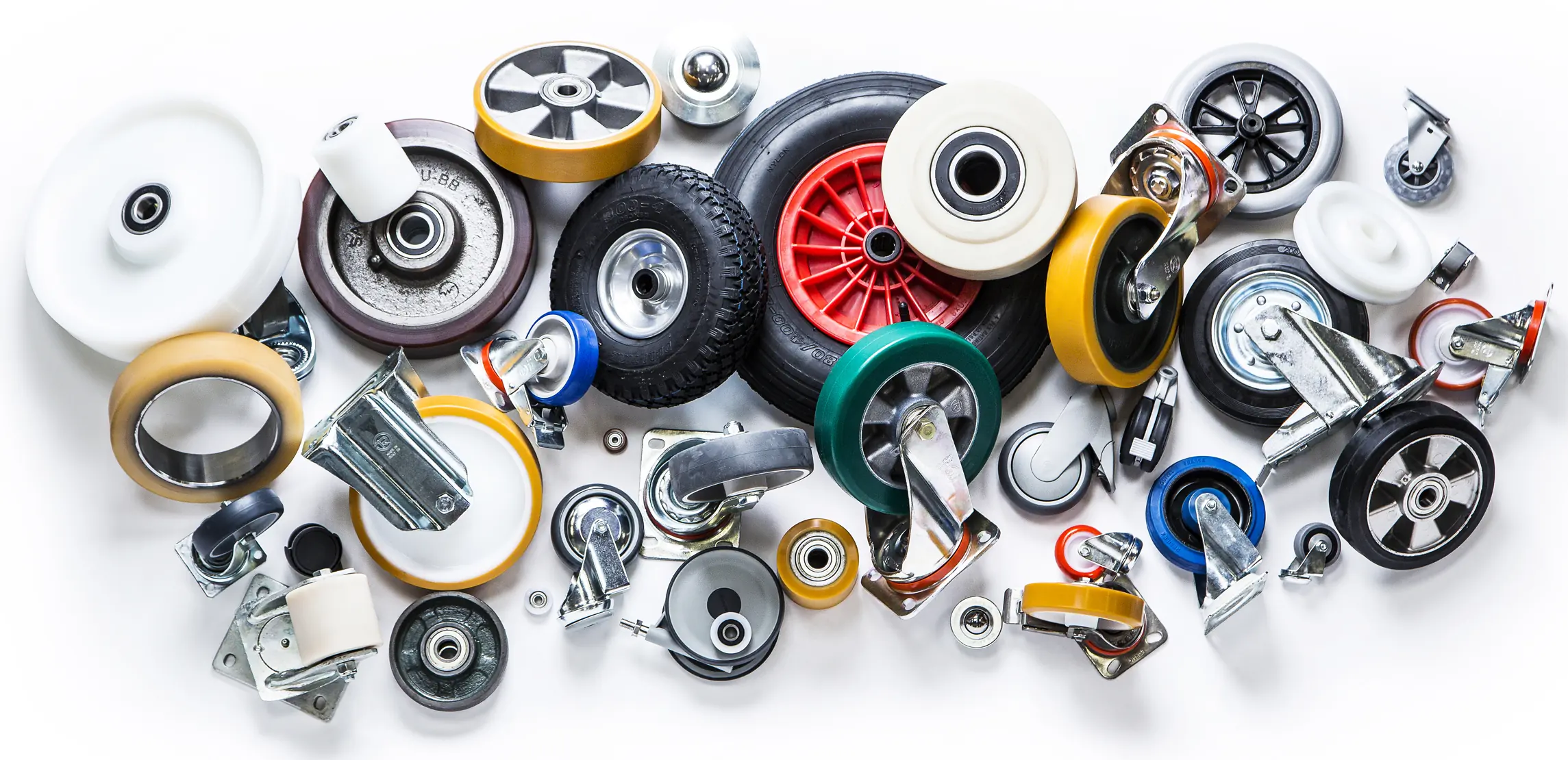
How can I combine swivel castors and fixed castors?
The swivel castor turns in the desired direction. It can be steered.
The fixed castor is locked in a single direction.
4 swivel castors: Suitable for confined spaces. The unit can be moved in all directions. Less suitable for long straight-line travel, as it is not directionally stable (one swivel castor could be fitted with a directional lock).
2 swivel castors / 2 fixed castors: The most common configuration, good straight-line and cornering performance.
4 swivel castors / 2 fixed castors: A complex upgrade. Easy to steer by taking the weight off the swivel castors. Proven for heavy
loads and long trolleys.
3 swivel castors: Suitable for small loads. The trolley can be moved in all directions. Not suitable for long straight-line travel, due to lack of stability.
Load capacity and speed
As a general rule: the trolley’s own weight + load / divided by 3 = load capacity per roller
The load capacity depends on the speed of travel. For wheels and castors without specified speed ratings, a maximum speed of 4 km/h applies on smooth, level and clean floors without thresholds, grooves or rails at a standard temperature of 20°C. The load capacity specifications generally refer to wheels and castors for non-motorised equipment that moves at walking pace during normal operation and is not used in continuous operation.
What is a double stop?
The double lock prevents the wheel from turning and the swivel head of the swivel castor from rotating.
The wheel lock only locks the wheel.
What is a wheel chock?
The wheel lock simply locks the wheel in place.
A distinction is made between a double stop and a wheel lock. The double stop brakes the wheel. It blocks both the rotational movement of the wheel and the rotational movement of the castor’s fork head.
What is a directional lock?
The directional lock allows a swivel castor to be temporarily converted into a fixed castor. The swivel movement of the castor is locked. The directional lock can be engaged and released with a light press of the foot.
The directional lock significantly improves the straight-line stability of a swivel castor over longer distances or in narrow aisles; indeed, simply fitting the trolley with a directional lock is sufficient to make manoeuvring in a narrow corridor easier, for example.
Which wheel bearing is suitable for my application?
Plain bearings: The term is somewhat misleading, as in these wheels the wheel runs directly on the axle (no bearing). Particularly suitable for slow-moving vehicles; robust and low-maintenance, but sluggish under heavy loads.
Roller cage bearings: A robust bearing type for slow-moving vehicles, smoother-running than plain bearings, the standard solution for many transport trolleys, largely maintenance-free.
Ball bearings: The bearing type with the lowest rolling resistance and the highest load capacity. Vehicles can be pushed easily even under heavy loads.
Maintenance: occasional lubrication recommended.
What wheel diameter do I need?
This depends on the load capacity. For aesthetic reasons, a small wheel is often chosen. However, a larger wheel offers significant advantages in everyday use, such as making it easier to negotiate obstacles like thresholds or requiring less effort to push the trolley.
Wheels with ball bearings and convex tyres run particularly smoothly.
Generally speaking, the larger the wheel, the easier it is to push the trolley.
Which roller is suitable for which type of ground?
Essentially, the chosen castor must be suitable for the type of floor in order to perform optimally. Here are a few suggestions:
Concrete floor – polyamide (rather loud), polyurethane, Vulkollan® (rather quiet), highly elastic solid rubber (very quiet)
Light-coloured floor – grey solid rubber or other non-marking castors
Gravel floor – pneumatic tyres (as large a wheel diameter as possible)
Soft floor = hard wheel, e.g. polyamide
Hard floor = soft wheel, e.g. solid rubber
What is Shore hardness?
The Shore hardness provides information about the hardness of the wheel material. There are two scales:
Shore A and Shore D
The higher the Shore hardness, the harder the material.
Example: Solid rubber has a Shore hardness of A 69, whilst polyurethane has a Shore hardness of A 95. Solid rubber is therefore considerably softer.
Shore hardness A 25 is roughly equivalent to the hardness of a rubber band.
Shore A 70 corresponds to the hardness of a men’s shoe heel.
What is the difference between polyamide and Pevolon?
In principle, they are the same. Both are rollers made from polyamide-based thermoplastic. Pevolon is a registered trademark.
As the name was introduced over 30 years ago, it is a household name in the wheel industry. It guarantees consistent quality.
What is the difference between polyurethane and Vulkollan®?
Both are very high-quality materials used in wheel manufacturing. They are mainly used for heavy loads and in challenging operating conditions.
Polyurethane is highly abrasion-resistant and therefore has a very long service life. Polyurethane meets the requirements in most cases.
Vulkollan® is the top-of-the-range product in wheel technology. It meets the highest standards in terms of load capacity, abrasion resistance and service life. Furthermore, Vulkollan® often exhibits high resistance to acids and other substances.
Guidelines and standards
ROHS
The ROHS Directive regulates restrictions on certain substances in electrical and electronic equipment. All our wheels and castors marked with the ROHS symbol do not contain any substances whose use is prohibited under ROHS.
If you are using older FTA castors, we will be happy to provide you with information regarding ROHS compliance.
STANDARDS AND GUIDELINES
FTA products generally comply with the relevant DIN, EN and/or ISO standards. If the standard you are looking for is not mentioned in our product description, please contact us. This applies in particular to electrically conductive castors.
What does ‘streak-free’ mean?
'Non-marking' means that these wheels do not leave unsightly marks or streaks on floors. Non-marking wheels are therefore ideal for use wherever attractive flooring is a priority.
Particularly suitable: grey solid rubber, polyamide, polyurethane and Vulkollen®.
Bicycle materials
If the trolley is constantly under load and is rarely moved, we recommend a hard wheel material such as polyamide.
If you want a very smooth ride, soft polyurethane or solid rubber wheels are the best choice.
Please also note our advice regarding the floor.
The climate
Extreme heat, cold, humidity and dryness have a significant impact on service life and performance.
In wet, deep-freeze and food processing environments, choose stainless steel rollers. Polyamide is a material that is highly resistant to cold and hygienic, and which also withstands temperature fluctuations well.
For temperatures up to 80°C, we recommend high-temperature-resistant rollers or cast iron rollers without grease in the yoke.
The housing types
Lightweight housing NL and NLX – up to 4 km/h – load capacity up to 400 kg
Medium-duty housing M – up to 4 km/h – load capacity up to 500 kg
Heavy-duty housing P and PX – up to 6 km/h (not for continuous use) – load capacity up to 750 kg
Heavy-duty housing PT – up to 6 km/h (not for continuous use) – load capacity up to 900 kg
Extra-heavy-duty housing EP – up to 6 km/h – load capacity up to 1600 kg
Electro-welded housing EE MHD and EEG MHD – up to 16 km/h (load capacity is reduced at speeds over 4 km/h) – load capacity up to 1500 kg
Electrically welded housing EE HD and EE EHD – up to 16 km/h (load capacity is reduced at speeds above 4 km/h) – load capacity up to 3500 kg
Electro-welded double housing EEG HD and EEG EHD up to 16 km/h (load capacity is reduced at speeds exceeding 4 km/h) – load capacity up to 4300 kg
What is ESD?
ESD stands for Electrostatic Discharge
When two objects with different charges come into contact, an electrostatic discharge occurs, which can impair the functionality of sensitive components.
Examples include the shock felt when touching a door handle or the discharge that occurs in dry air.
What should I bear in mind when buying tyres?
Surroundings
Smooth running
Chemicals, cleaning agents, oils
Metal shavings, dirt or threads on the floor
Load capacity and speed
Tare weight of trolley + payload
Climate
Heat, cold, humidity and dryness
Ground
Soft ground = hard tyres
Hard ground = soft tyre
Wheel material
If the trolley is under constant load and is rarely moved, we recommend a hard wheel material such as polyamide.
If you require a very smooth ride, soft polyurethane or rubber wheels are the first choice.
Wheel size
Depends on the load capacity. Smaller wheels are often chosen for aesthetic reasons. However, larger wheels offer significant advantages in everyday use.
Easy navigation over obstacles – less effort required to push the trolley.